✦ All Cookings ✦
The Art of Michelin Star Desserts
The Complete Guide
Professional techniques. Restaurant-quality results. Every secret the pastry chefs don’t tell you — explained clearly, so you can execute them in your own kitchen.
What is a Michelin Star Dessert?
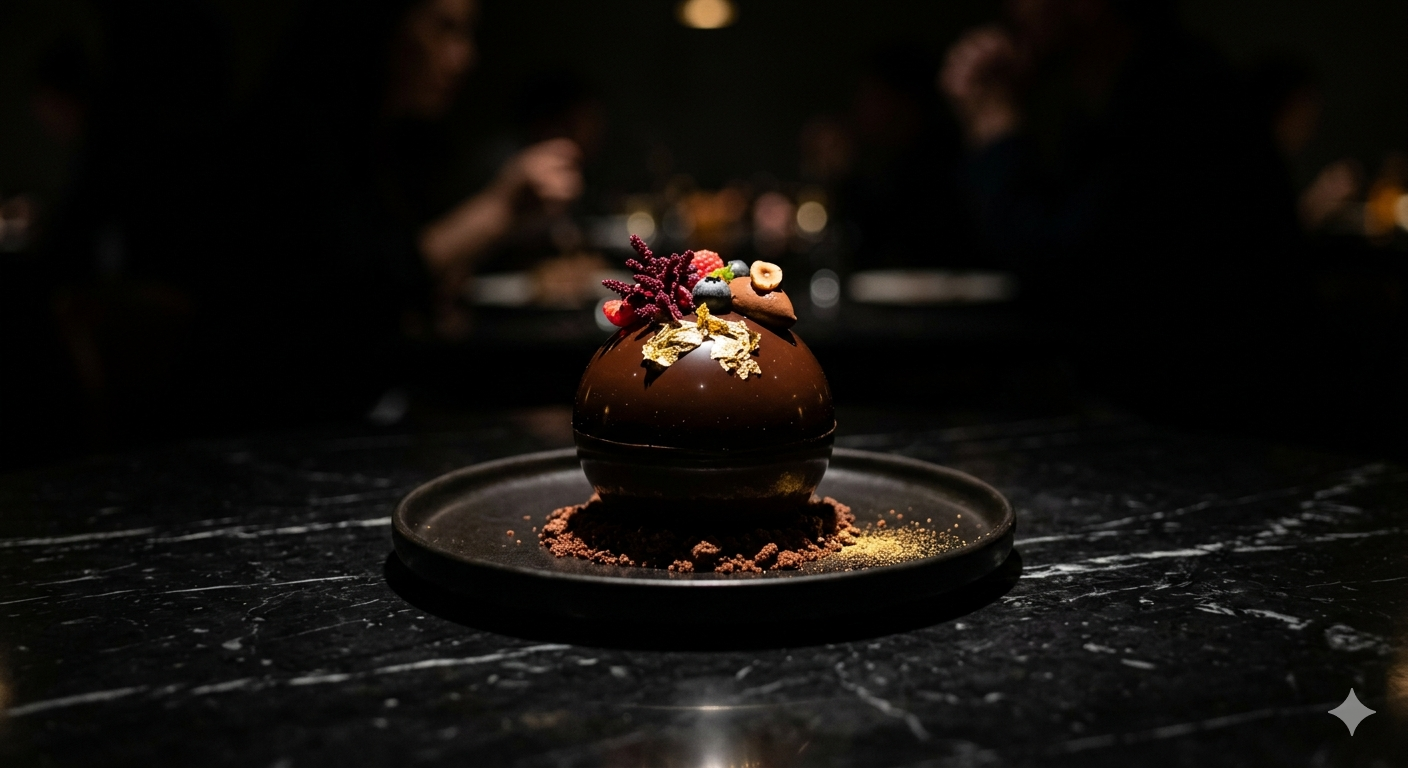
A Michelin star dessert is not simply a very good dessert. It is a composed, multi-element plate in which every component — texture, temperature, flavour, colour, and structure — has been considered and calibrated to work in concert. When you eat one, you are not just tasting ingredients. You are experiencing a piece of culinary architecture.
The Michelin Guide has awarded stars to restaurants since 1926. A one-star restaurant is defined as “a very good restaurant.” Two stars: “excellent cooking, worth a detour.” Three stars: “exceptional cuisine, worth a special journey.” The dessert course in a starred kitchen must meet the same standard as every other course — and in many of the world’s greatest restaurants, it is the dessert that the diner remembers longest.
What separates these desserts from everything else is not magic or impossible technique. It is knowledge, precision, and intent. And all three are learnable.
The 5 Principles Behind Every Michelin Star Dessert
01 — Texture Contrast
Every great plated dessert has at least three distinct textures — typically something crisp, something creamy, and something aerated or liquid. The interplay between them is what makes each bite dynamic and engaging.
02 — Temperature Contrast
Hot and cold on the same plate is one of the most powerful tools in the pastry kitchen. A warm fondant beside a cold ice cream quenelle. A room-temperature ganache against a frozen aero. Temperature contrast creates drama and surprise.
03 — Flavour Coherence
Every element must earn its place through flavour. A garnish that adds nothing but colour is a missed opportunity. In a Michelin kitchen, even the micro herb is chosen for taste, not decoration. Ask of every element: does this make the plate taste better?
04 — Visual Composition
A Michelin plate is plated off-centre, with deliberate negative space. Elements are placed with tweezers and spoons, not poured or dumped. The plate is a canvas. Three well-placed elements always beat six carelessly scattered ones.
05 — Conceptual Narrative
The best Michelin desserts have a story. Île Flottante is about lightness and French classicism. The Popcorn Cinema Homage is about nostalgia. Fluido is about the moment of revelation. Your dessert should be able to be explained in one sentence — and that sentence should create anticipation before the first bite.
Essential Techniques You Need to Master
Before attempting a composed Michelin dessert, there are a handful of foundational techniques that appear again and again across the entire repertoire. Master these and most professional recipes become accessible.
Crème Anglaise
The mother sauce of the pastry kitchen. Master this and you can make ice cream, mousse, bavarois, crème brûlée, and île flottante. Cook to exactly 82°C, never more. Use a digital thermometer.
Tempered Ganache
The foundation of every chocolate-based Michelin dessert. The ratio of cream to chocolate and the temperature at which you combine them determines whether you get a pourable sauce, a spreadable ganache, or a sliceable délice.
Italian Meringue
Hot sugar syrup poured into whipping egg whites creates a stable, glossy, safe meringue that holds for hours. Used in île flottante, lemon tart, macarons and dozens of other classical preparations. Target 121°C for the syrup.
Spherification
Sodium alginate + calcium chloride = liquid-filled pearls that burst on the tongue. Used in the Earl Grey & Yuzu Texture Study. Once understood, this technique opens up endless flavour possibilities.
Aero / Siphon Technique
An iSi cream whipper charged with N₂O cartridges transforms any liquid into a foam, espuma, or aerated solid. Used in the Popcorn Cinema Homage, Liquorice & Carrot, and Dulcey & Hazelnut Architecture.
Quenelle
The three-spoon technique for creating a smooth, pointed oval of ice cream, mousse or sorbet. It is the single most visible marker of professional plating. Practice with mashed potato before attempting with ice cream.
The Professional Pastry Toolkit
You do not need a professional kitchen. But you do need the right tools. These are the items that appear in every Michelin dessert recipe on this site — invest in them once and use them for years.
Non-Negotiable
Digital thermometer
iSi cream siphon (0.5L)
N₂O cartridges
Silicone hemisphere moulds
Fine mesh sieve
Plating tweezers
Strongly Recommended
Ice cream machine
Stand mixer
Piping bags + nozzle set
Kitchen blowtorch
Digital scale (0.1g precision)
Offset spatula
For Advanced Techniques
Sodium alginate
Calcium chloride
N-Zorbit M (tapioca maltodextrin)
Agar-agar powder
Edible gold leaf sheets
Dariole moulds
★ The Collection
All Michelin Star Series Recipes
Every recipe in the series — from foundational French classics to technically ambitious composed plates.

★ Expert · 3 hours
A warm golden fondant with a flowing egg yolk and white chocolate core. The most dramatic reveal in the collection.

★ Expert · 4 hours
Every flavour and texture of the cinema experience, rebuilt through Michelin fine dining technique.
Dulcey & Hazelnut Architecture
★ Expert · 4 hours
One ingredient — the hazelnut — explored across five textures simultaneously on a single plate.
Earl Grey & Yuzu Texture Study
★ Advanced · 3 hours
Ganache, jelly, dacquoise and spherification pearls — molecular gastronomy in service of pure flavour.

★ Advanced · 2 hours
The great underexplored pairing of earthy liquorice and sweet carrot — a plate of extraordinary elegance.

★ Advanced · 45 mins
The crown jewel of French classical patisserie — billowing meringue on silky crème anglaise with spun caramel.

★ Advanced · 45 mins + chill
The silkiest Valrhona chocolate ganache tart in fine dining — finished with edible gold leaf and raspberry coulis.
Crème Brûlée
★ Intermediate · 1 hour
Silky vanilla custard with a flawless caramelised sugar crust — the exact temperatures and torch technique used in French restaurants.
How to Plate Like a Michelin Chef
Plating is not decoration. It is the final act of cooking — and it communicates everything about your intention and skill before the first bite is taken.
Rule 1 — Warm the Plate
Every hot component goes on a warm plate — 40°C in an oven for 5 minutes. A cold plate drops the temperature of your dessert immediately and kills the eating experience.
Rule 2 — Off-Centre
Never place the main element in the dead centre of the plate. Place it at roughly 7–8 o’clock on a round plate. This creates visual movement and negative space.
Rule 3 — Three Elements Maximum
On a small plate, three well-placed elements are always more powerful than six scattered ones. Restraint is sophistication. If you have more components, group them intentionally.
Rule 4 — The Sauce Swoosh
The classic Michelin sauce placement is a bold arc — a large spoon placed at one point, then pulled across the plate in a sweeping motion. It should be confident, not tentative. Practice on a cold plate first.
Rule 5 — Use Tweezers
Plating tweezers are not optional. Gold leaf cannot be placed by hand. Micro herbs cannot be positioned by hand. Pearls cannot be arranged by hand. Buy a pair of 20cm stainless tweezers and use them for every garnish.
Rule 6 — Clean the Rim
Before the plate leaves the pass, wipe the rim with a clean, damp cloth. Any sauce drop or smear on the rim signals carelessness. In a Michelin kitchen this is never skipped — and it should never be skipped at home.
★ All Cookings Shop
Take Your Skills Further
Download the complete professional recipe guides — full ingredient quantities, exact temperatures, step-by-step methods and plating diagrams for every dessert in the Michelin Star Series.
Discover more from ALL COOKINGS
Subscribe to get the latest posts sent to your email.