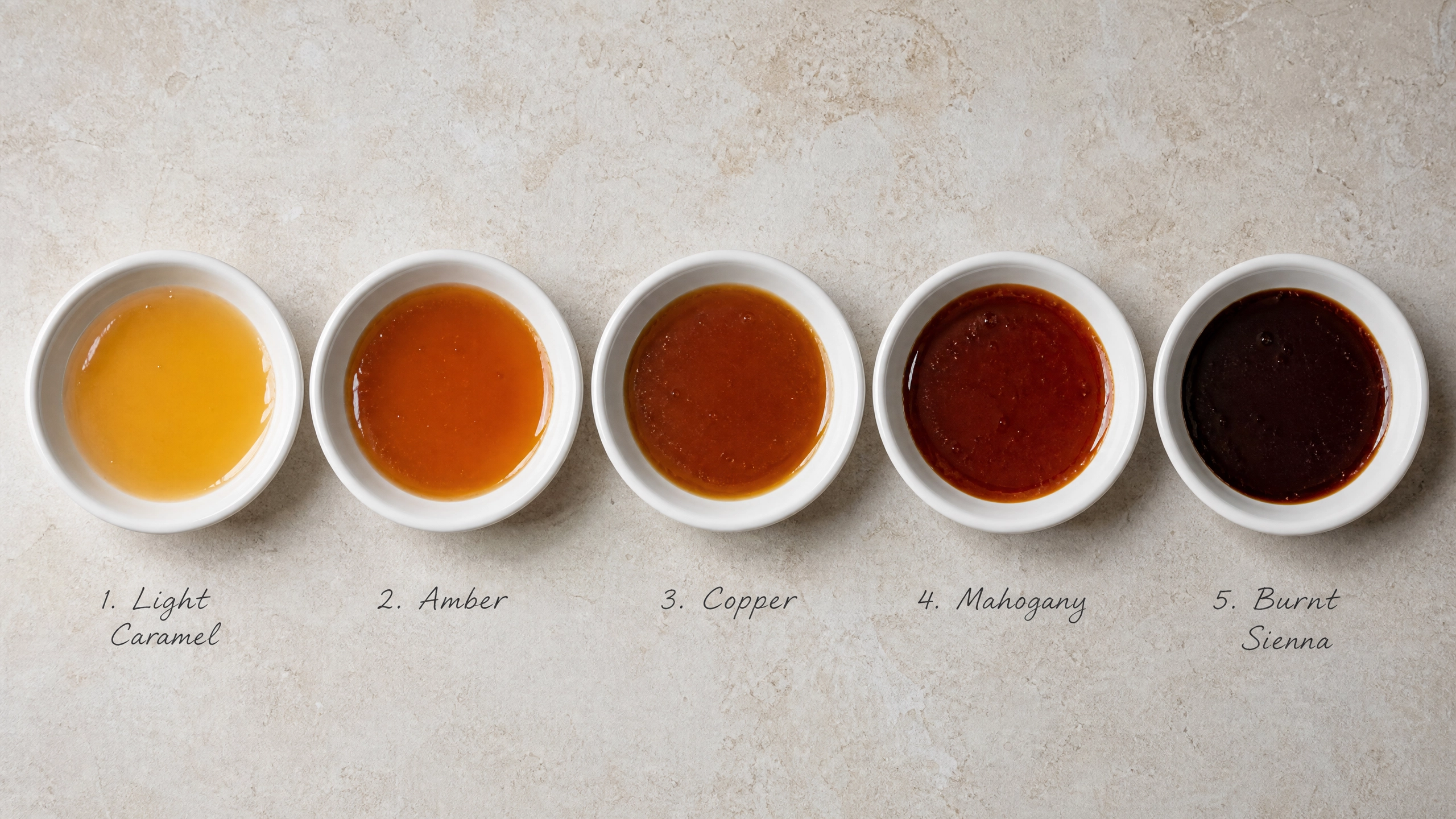
Every pastry student learns about sugar. Sweetness, caramelisation, syrup stages — these are foundational. What is rarely taught is that in professional kitchens, sugar is not used primarily for sweetness. It is used for texture, for colour, for moisture control, and for structural architecture. Sweetness is almost secondary.
Understanding how sugar behaves at different stages of cooking, and why Michelin pastry chefs use it the way they do, will change how you approach every dessert you make. Not because you will necessarily change your recipes, but because you will understand what you are doing rather than simply following instructions.
The Sugar Stages and What Each One Actually Does
Sugar dissolved in water and heated passes through identifiable physical stages, each with specific applications in pastry. The temperature references below assume you are working at sea level. Dubai and other high-altitude cities require small adjustments (subtract approximately 1°C per 300m of elevation).
Thread Stage: 106–113°C

At this temperature, sugar syrup dropped into cold water forms thin threads. In professional kitchens this stage is used for moistening baba, dipping fruits, and making spun sugar. It is also the stage used for Italian meringue preparation — the syrup is poured into whipping egg whites at exactly 121°C to pasteurise the eggs and create a stable, shiny meringue that holds structure without collapsing or weeping. Temperature precision at this stage is critical. Under 118°C and the meringue will weep. Over 124°C and the syrup will seize on contact with the whites.
Soft Ball: 113–118°C
Used for fudge, fondant and buttercream. The sugar retains moisture and produces a pliable, yielding texture when set. Fondant — the smooth, white confection used to glaze éclairs and mille-feuille — is made by cooking syrup to 116°C, cooling it to around 40°C, then agitating it vigorously until it crystallises into an opaque, smooth paste. The agitation is essential: it produces millions of microscopic crystals that give fondant its smooth melt on the palate. Large crystals produce a grainy texture — the sign of poor fondant technique.
Firm Ball: 118–121°C
The range for Italian meringue and most French buttercreams. At this temperature, the sugar solution is concentrated enough to pasteurise egg whites on contact, but fluid enough to incorporate smoothly without seizing. This is the stage professional pastry chefs return to most frequently — the same principle carries over to pâte à bombe, where hot syrup is poured into whipping egg yolks instead of whites, cooking them safely while building the aerated structure behind desserts like our Tropical Mango Coconut Tiramisu, and its plant-based counterpart, our Vegan Tiramisu, which uses the same technique with whipped aquafaba in place of egg yolks.
Hard Crack: 149–154°C

Used for pulled sugar, blown sugar, nougatine and praline. At this temperature most of the water has evaporated and the sugar is almost entirely sucrose. It sets rigid and glassy on cooling. Nougatine — the caramelised almond brittle that forms the base of many plated desserts — is made at hard crack, combined with toasted nuts, then rolled thin and cut before it sets. The window between workable and brittle is roughly 90 seconds, which is why professional kitchens keep it under heat lamps during shaping.
Caramel: 160–180°C
This is where sucrose breaks down entirely and the Maillard reaction and pyrolysis produce hundreds of new flavour compounds. The colour shifts from amber to deep copper to mahogany. The flavour shifts from butterscotch to bitter toffee to burnt. Professional pastry chefs typically use caramel at 170–175°C for sauces and glazes — complex, slightly bitter, with depth. Lighter caramel (160°C) is sweet and one-dimensional. Dark caramel (above 180°C) is acrid and irreversible. The difference between them is often less than 10 seconds on the heat — see our Salted Caramel Chocolate Délice for this exact stage in practice.

How Professional Pastry Chefs Actually Use These Stages
Sugar as Moisture Control
Sugar is hygroscopic — it attracts and retains moisture from its environment. This is why a cake or biscuit with higher sugar content stays moist longer than a lower-sugar one. Inverted sugar (glucose + fructose, made by hydrolysing sucrose) is even more hygroscopic than caster sugar, which is why professional ganaches and ice cream bases use trimoline or glucose syrup — it keeps textures soft and prevents crystallisation in frozen products.
Sugar as Structure
In a baked cake, sugar delays gluten network formation and protein coagulation by competing with them for water. This is why high-sugar cakes are tenderer than low-sugar ones — less gluten develops during mixing. The same principle explains why adding sugar to a meringue stabilises it: sugar raises the temperature at which the egg white proteins coagulate, giving you more time to build the foam before it sets. Remove sugar from a meringue and it collapses almost immediately when heated.
Sugar as Colour
Reducing sugars (glucose, fructose, lactose) participate in the Maillard reaction when heated with amino acids from proteins. This is what produces the golden colour on a baked croissant, the dark crust on a brioche, the caramelised surface of a crème brûlée. Professional egg washes include milk (lactose) precisely because the additional reducing sugar accelerates browning. A pure egg wash browns more slowly and less deeply than one extended with milk or cream.
The Professional Discipline: Temperature, Not Guesswork

In a professional kitchen, sugar work is never done by eye alone. A probe thermometer is essential equipment, not optional. Home baking guides often suggest the “cold water test” as a substitute for a thermometer — dropping syrup into cold water and feeling the texture. It works in principle but introduces variables: the temperature of the water, the speed of your hands, the air temperature. A thermometer removes all of those variables.
If you bake seriously, a digital probe thermometer is the single piece of equipment that will improve your results more than any other purchase. Not a stand mixer. Not a silicone mat. A probe. Temperature is information. Without it, you are guessing.
Part of the Michelin Star Series on allcookings.com — the science and technique behind professional pastry, broken down for the serious home baker.
Discover more from ALL COOKINGS
Subscribe to get the latest posts sent to your email.