Part of the Michelin Star Series — a study of the techniques, philosophies, and visual language of fine-dining pastry.
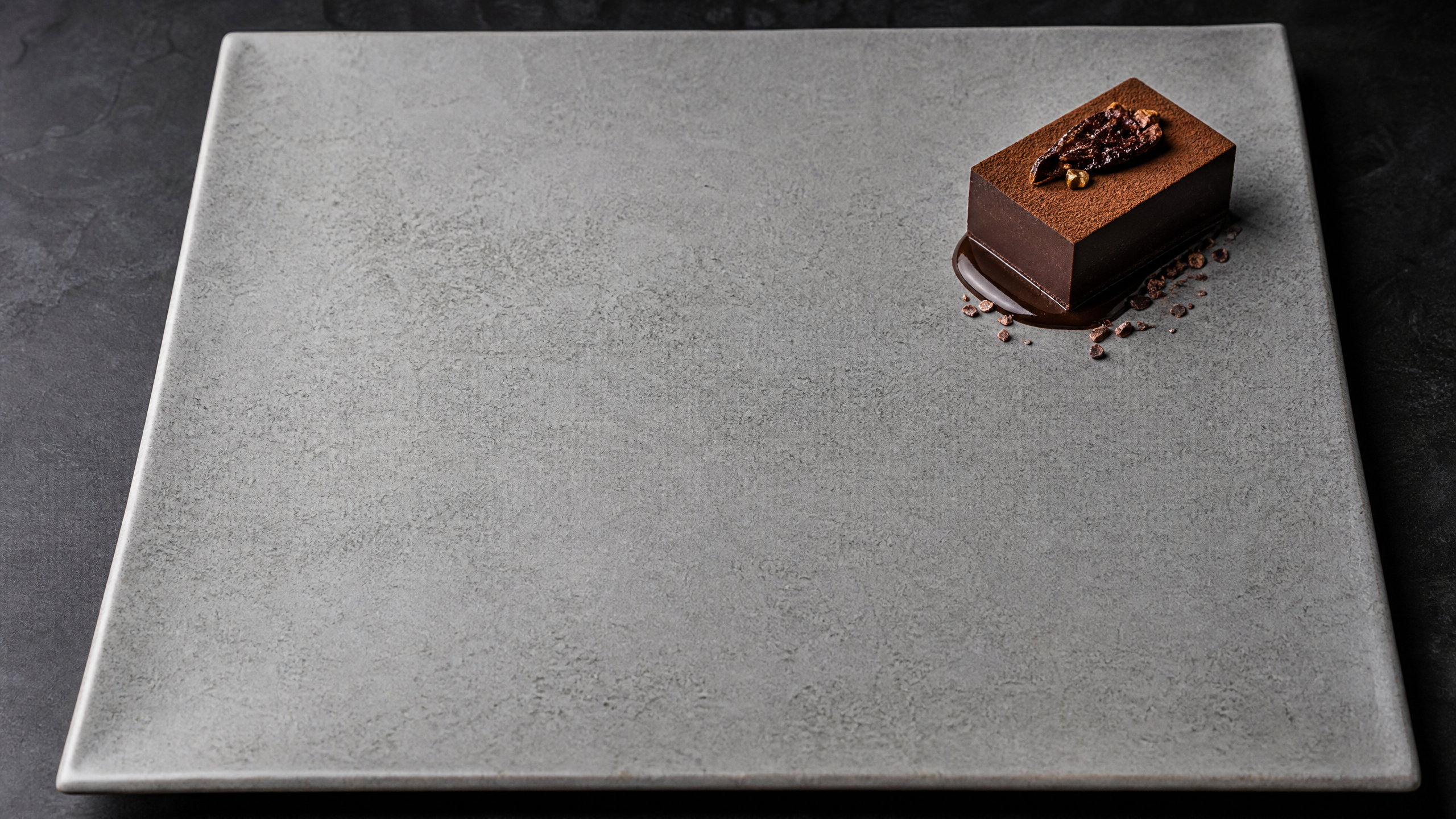
There is a moment, studying a great dessert plate, when you stop looking at the food and start looking at the porcelain around it. The empty space. The deliberate nothing. And you realise that the chef has thought as carefully about what is absent as about what is present. This is the grammar of negative space — one of the most sophisticated and least discussed tools in fine-dining pastry.
What Negative Space Actually Is

In visual composition, negative space is the area surrounding the subject — the background, the void, the unoccupied field. On a dessert plate it is managed through porcelain, and its dimensions are fixed: you cannot make the plate larger to create more space, so every decision about placement is also a decision about how much emptiness remains and where it falls. Negative space is not passive. It is not the absence of a decision — it is a decision in itself.
Weight Without Mass

Empty areas carry visual weight. A large field of dark slate porcelain on the lower half of a plate pulls the eye downward with considerable force. A single component placed at the upper third sits against that weight, held there by the tension between its position and the gravitational pull of the void beneath it. The result is a plate that feels dynamic, almost precarious. This is why the choice of plate matters enormously at the Michelin level. White negative space recedes. Dark negative space advances. Neither is correct. They are different sentences making different arguments.
The Direction of Emptiness

Advanced plating uses negative space not just as backdrop but as vector — a force that implies movement or draws the eye through the composition in a deliberate sequence. A quenelle placed at a slight diagonal angle does not simply sit on the plate; it points. The eye follows the long axis of the form and arrives somewhere. The chef is choreographing where the diner looks and in what order. This borrows directly from the conventions of Japanese calligraphy and ikebana, both of which treat empty space as the medium through which the eye travels between points of interest.
The Discipline of Subtraction

Perhaps the hardest skill in modern plating is knowing what to remove. The instinct, particularly early in a pastry career, is additive: another element will complete the plate, another garnish will finish it. This instinct is almost always wrong. Every additional element placed on a plate consumes negative space and reduces the visual weight of every other element already there. The discipline of subtraction is the practice of removing elements until what remains feels inevitable — until you cannot imagine the plate without any single component, and cannot imagine adding one more. The space is what makes each element matter.
Practical Application: Three Ratios

Negative space operates most usefully as a ratio — the proportion of occupied to unoccupied plate surface. A plate where 60–70% of the surface is occupied reads as abundant and classical. A plate at 40–50% occupied sits in the nouvelle cuisine tradition: balanced, purposeful. A plate below 30% occupied — where 70%+ is void — enters the territory of the quiet plate: severe, editorial, demanding. This last ratio is the hardest to execute because every element must carry enormous individual weight. There is no visual noise to absorb weak components.
This post is part of the Michelin Star Series. Read the companion essay — The Evolution of Modern Dessert Plating — for the historical context behind the quiet plate aesthetic this piece explores.
FREE GUIDE ✦ INSTANT DOWNLOAD
Want to plate like a Michelin-star chef?
Get the free PDF guide — 5 plating secrets from a professional pastry kitchen, sent directly to your inbox.
Discover more from ALL COOKINGS
Subscribe to get the latest posts sent to your email.