The Laminated Luxury Series — No. 2 of 8
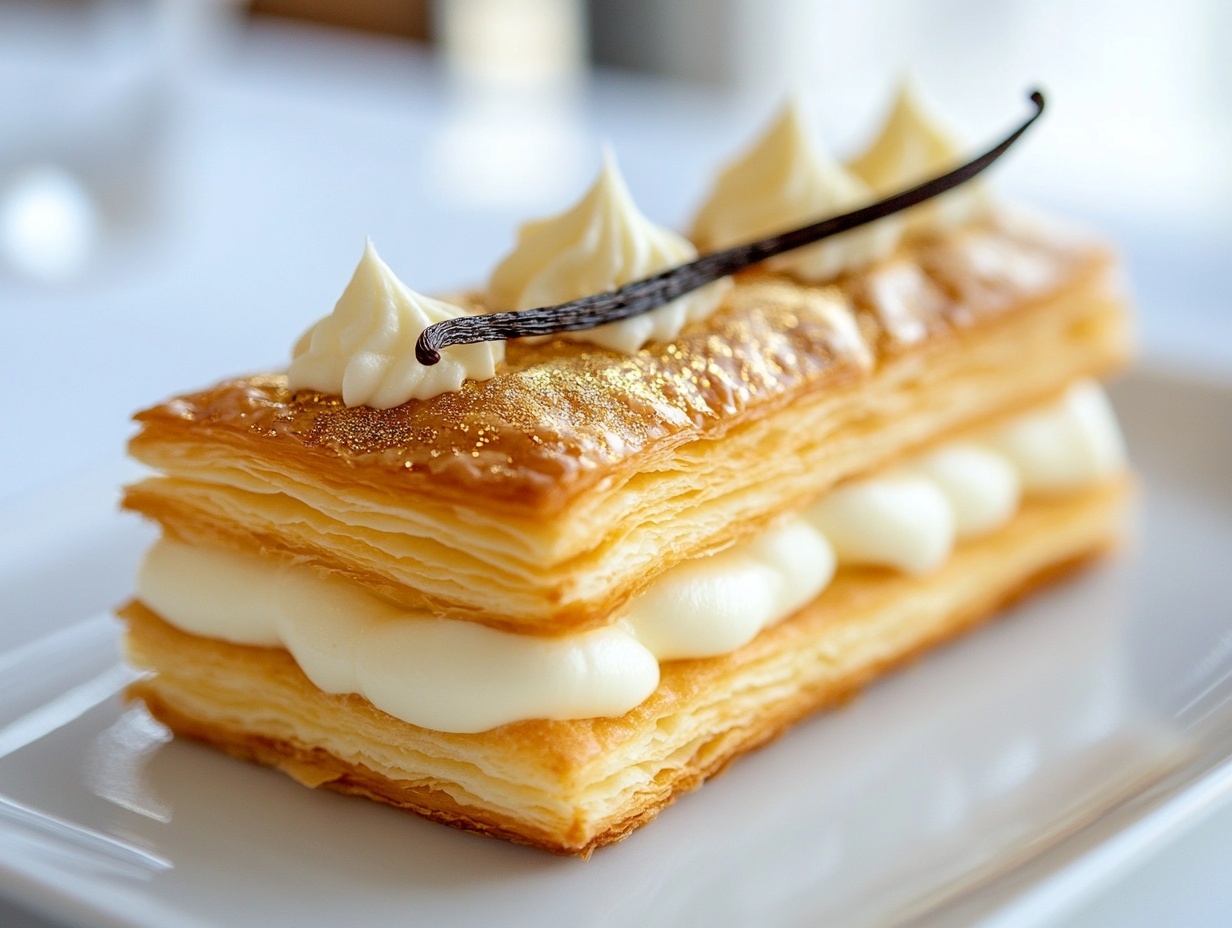
If the Noir Croissant is darkness, this is light. The Tahitian Vanilla Mille-Feuille Croissant takes the most revered ingredient in patisserie — the Tahitian vanilla bean, with its floral, cherry-like complexity — and anchors it inside shatteringly crisp laminated layers, bound together with a diplomat cream of exceptional delicacy.
Mille-feuille means a thousand leaves. Here, those leaves are croissant dough — caramelised, lacquered, and finished with edible gold dust. This is the series at its most classical.
Chef’s Note
Tahitian vanilla is not interchangeable with Madagascar vanilla. It is softer, more floral — less sharp. It perfumes the cream rather than asserting itself. Use real pods, not extract. Split them lengthways, scrape every seed, and steep the pods in the warm milk for a minimum of 20 minutes. The difference is not subtle.
The croissant layers here are baked flatter than usual — pressed lightly before baking to encourage the mille-feuille effect. The result is a pastry of extraordinary crunch and layering, designed to shatter on the first bite and yield something impossibly soft inside.
Ingredients
The Dough
- 500g strong bread flour
- 10g fine sea salt
- 80g caster sugar
- 10g instant yeast
- 300ml whole milk, cold
- 30g unsalted butter, softened
The Butter Block (Beurrage)
- 280g European-style unsalted butter (84% fat), cold
Tahitian Vanilla Diplomat Cream
- 500ml whole milk
- 2 Tahitian vanilla pods, split and scraped
- 5 egg yolks
- 120g caster sugar
- 40g cornflour
- 30g unsalted butter, cold and cubed
- 200ml double cream, whipped to soft peaks
Lacquer Glaze
- 100g caster sugar
- 30ml water
- 1 tsp glucose syrup
To Finish
- 1 egg yolk + 1 tbsp cream (egg wash)
- Edible gold dust
- Vanilla pod, halved, to garnish
Method
Day 1 — The Détrempe & Beurrage
Combine flour, salt, and sugar. Dissolve yeast in the cold milk, then combine with the dry ingredients. Add the softened butter and knead for 8 minutes until smooth and elastic. Wrap and refrigerate overnight. Shape the cold butter block into a 20cm square and refrigerate alongside the dough.
Day 2 — Lamination
Perform three double folds with 30-minute rests between each fold, keeping everything below 18°C. After the final fold, rest for at least 1 hour.
Shaping — The Mille-Feuille Method
Roll the laminated dough to 4mm. Rather than rolling into the traditional crescent shape, cut into rectangles (12cm × 8cm). Stack two rectangles per pastry with a light brushing of egg wash between them. Place on lined trays and proof at 24°C for 1.5–2 hours. Before baking, place a second sheet of parchment on top and weigh down lightly with a flat baking tray — this creates the compressed, layered mille-feuille effect.
Baking & Glazing
Preheat oven to 185°C (fan). Brush with egg wash, then bake with the weighted tray on top for 15 minutes. Remove the top tray and bake a further 8–10 minutes until deeply golden and lacquered. While still hot, brush immediately with the sugar glaze (combine sugar, water, and glucose, simmer until syrupy). The glaze will set to a glassy finish as it cools.
The Diplomat Cream
Steep the split vanilla pods in the warm milk for 20 minutes. Whisk the egg yolks with sugar and cornflour. Bring the milk back to a simmer, remove pods, then pour over the egg mixture in a steady stream. Return to the pan and cook over medium heat, whisking constantly, until thick and glossy. Remove from heat, whisk in the cold butter. Press cling film directly onto the surface and cool completely. Once cold, fold in the whipped cream in two additions to create a light, airy diplomat cream.
Assembly
Once the pastries are completely cool, split horizontally with a serrated knife. Pipe the diplomat cream generously across the base — use a large star nozzle for visual drama. Replace the top layer. Dust liberally with edible gold dust and place a halved vanilla pod across the top. Serve within 2 hours of assembly for maximum crunch.
Technique Notes
The weighted bake. Pressing the dough during baking forces the layers to caramelise against each other rather than puffing apart. The result is a pastry that is more mille-feuille than croissant — dense with crunch, not airy. Do not skip this step.
The glaze timing. The sugar glaze must go on immediately out of the oven while the surface is still hot. A cold pastry will not absorb the glaze — it will pool and remain sticky. Work quickly.
Diplomat vs. pastry cream. Diplomat cream is pastry cream lightened with whipped cream. Do not substitute with pastry cream alone — it is too dense and will overwhelm the delicate vanilla perfume. The lightness of the diplomat cream is essential to the balance of this pastry.
Facebook Caption
The Laminated Luxury Series continues.
Crisp laminated layers. Tahitian vanilla diplomat cream. Edible gold dust.
This is the Tahitian Vanilla Mille-Feuille Croissant — and it tastes exactly as extraordinary as it looks.
Full recipe on the blog. Link in bio. ✨🥐
The Laminated Luxury Series
← No. 1 — Noir Croissant | You are reading No. 2 — Tahitian Vanilla Mille-Feuille
Next: No. 3 — Saffron & Honey Kouign-Amann →
View the full series: French Classics | Michelin Star Series
🖤 Want All 8 Recipes in One Place?
The complete Laminated Luxury Series — all 8 Michelin-level croissant recipes, technique notes, plating guides, and photography direction — is available as a premium recipe collection in our shop.
Discover more from ALL COOKINGS
Subscribe to get the latest posts sent to your email.