★ Michelin Star Series ★
Tropical Mango Coconut Tiramisu
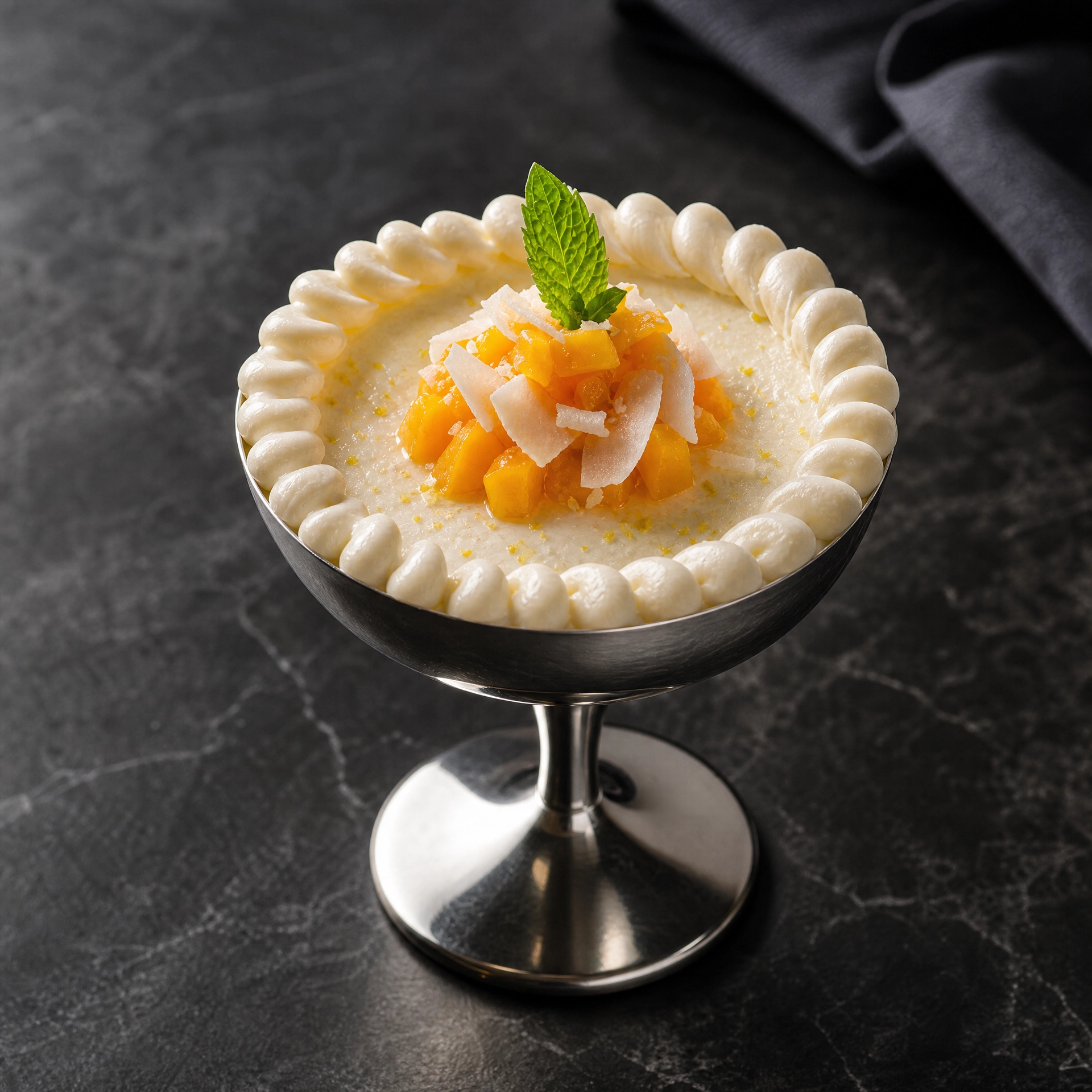
The Italian classic reimagined — coconut-laced mascarpone cream, soaked ladyfingers, and a bright mango-passionfruit coulis, built and finished in the glass.
⏱ Prep: 1.5 hours · ⏲ Chill: 4 hours · 🥭 Serves: 6 (200g each) · ⭐ Difficulty: Advanced

Tiramisu, Rebuilt Around the Tropics
Classic tiramisu is built on three fixed points: a pâte à bombe base for the mascarpone cream, coffee-soaked ladyfingers, and cocoa to finish. This version keeps the structure — the technique that actually makes tiramisu work — and swaps every flavour element for something brighter. Coconut cream folds into the mascarpone base alongside the traditional cream. Vanilla sugar syrup and coconut milk replace the espresso for soaking the ladyfingers. And in place of cocoa, a sharp mango-passionfruit coulis, set with agar-agar, sits between the cream layers and again on top, finished with fresh mango, shredded coconut, mint and lemon zest.
The pâte à bombe technique is what separates this from a simple whipped-cream tiramisu. Sugar and water are cooked to a syrup and poured over whipping egg yolks, cooking them gently and safely while building volume — the same base technique behind Italian buttercream. It’s what gives the mascarpone cream its structure and its light, aerated set, rather than a heavy, dense texture.
Built in individual glasses and finished with the garnish right before service, this is designed to be assembled ahead and finished tableside — exactly how it would be handled in a professional pastry section.
⭐ Why This Recipe
✔️ Classic pâte à bombe technique
✔️ Coconut-mascarpone cream
✔️ Agar-set mango-passionfruit coulis
✔️ No coffee, no cocoa
✔️ Built and finished in the glass
✔️ Make-ahead friendly
✔️ Bright, warm-weather alternative
✔️ Restaurant plating guide
Ingredients (makes 6 servings, ~200g each)
Pâte à Bombe Syrup
96g caster sugar
40g water
64g egg yolk (about 3 large yolks)
Coconut-Mascarpone Cream
104g coconut cream
104g double cream
20g icing sugar
600g mascarpone, room temperature
8g gelatine (bloomed)
Ladyfinger Soak
150g coconut milk
40g vanilla sugar syrup
18–24 ladyfingers (savoiardi)
Mango-Passionfruit Coulis
100g mango purée
100g passionfruit purée
20g sugar
2g agar-agar powder
To Finish
1 fresh mango, diced small
2–3 tbsp reserved coulis (for mixing through mango)
Shredded/shaved fresh coconut
Fresh mint leaves
Lemon zest, finely grated
The Method
Step 1 — The Coulis (make first, needs time to set). Combine mango purée, passionfruit purée and sugar in a saucepan. Whisk in agar-agar powder while cold to avoid lumps. Bring to a full boil for 90 seconds, whisking constantly. Pour into a shallow container and refrigerate until fully set, about 1 hour. Once set, blend until smooth and spoonable — this becomes your layering and garnish coulis.
Step 2 — The Pâte à Bombe. Combine sugar and water in a small saucepan and cook to 121°C (soft-ball stage). Meanwhile, begin whisking egg yolks in a stand mixer on medium speed. Once the syrup reaches temperature, pour it in a thin, steady stream down the side of the bowl while whisking continuously — never directly onto the whisk. Continue whisking on high speed until the mixture is pale, thick, and cooled to room temperature, roughly 8–10 minutes.
Step 3 — The Cream. Bloom the gelatine in cold water. Whip coconut cream, double cream and icing sugar together to soft peaks. In a separate bowl, beat the mascarpone until smooth and loose — do not overwhip, or it will split. Gently melt the bloomed gelatine and stir a small amount of the mascarpone into it to temper, then fold this back into the rest of the mascarpone. Fold the pâte à bombe into the mascarpone in two additions, then fold in the whipped coconut cream mixture until fully combined and airy.
Step 4 — Soak the Ladyfingers. Combine coconut milk and vanilla sugar syrup in a shallow dish. Dip each ladyfinger briefly — a quick pass, not a soak — so they stay structured rather than turning to mush.
Step 5 — Build the Glass. Break soaked ladyfingers to fit the base of each glass. Pipe a layer of the coconut-mascarpone cream over the top. Add a thin layer of mango-passionfruit coulis. Repeat with a second layer of ladyfingers, then a final generous layer of cream, piped in the decorative border shown in the photo, leaving the centre slightly lower to hold the garnish. Refrigerate at least 4 hours, ideally overnight.
Step 6 — Finish Tableside. Just before serving, toss the diced mango with 2–3 tablespoons of the reserved coulis. Spoon into the centre of each glass. Top with shredded coconut, a sprig of fresh mint, and a fine grating of lemon zest.
Chef’s Secrets
01 — Pour the Syrup Slowly
Pouring hot syrup too fast, or directly onto the moving whisk, splashes hot sugar onto the bowl walls where it hardens instead of incorporating. A thin, steady stream down the side is what builds proper volume.
02 — A Quick Dip, Not a Soak
Ladyfingers left in liquid too long turn to paste and collapse the layers. A one-to-two second dip per side is enough — they’ll continue softening in the fridge overnight.
03 — Garnish Only at Service
The diced mango and coulis mixture will weep liquid onto the cream if added too early. Keep it separate and finish each glass in the last minutes before serving, exactly as done tableside.
Part of the Michelin Star Series on allcookings.com — restaurant-quality pastry techniques broken down for the serious home baker.
FREE GUIDE ✦ INSTANT DOWNLOAD
Want to plate like a Michelin-star chef?
Get the free PDF guide — 5 plating secrets from a professional pastry kitchen, sent directly to your inbox.
Discover more from ALL COOKINGS
Subscribe to get the latest posts sent to your email.